Sufi Shah Inayat Shaheed Poetry
This is the final of a four-part series on Shah Inayat, whose 300th death anniversary is now being commemorated. Read the first part here, the second part here and the third here.
We cannot say whether the story of the dialogue between Nawab Azam Khan and Sufi Shah Inayat is based on reliable evidence or the creation of the imaginative flight of some good-humoured admirer of Sufi Shaheed, however, there is no doubt that Sufi Shah Inayat kept firm on his principle of life. He did not stumble for even a moment.
According to the description of Tuhfat-ul-Kiram, Mian Yar Muhammad Kalhoro was awarded the villages of Lakri, Danda, Hajam, Dornak, Rajab, Pasar, Pachata, Thore and Daya Sain Dana from the area of Shamadati and Chachkaan as a prize. That is how the first experiment of collective farming and equal distribution of wealth in the Indus Valley came to an end.
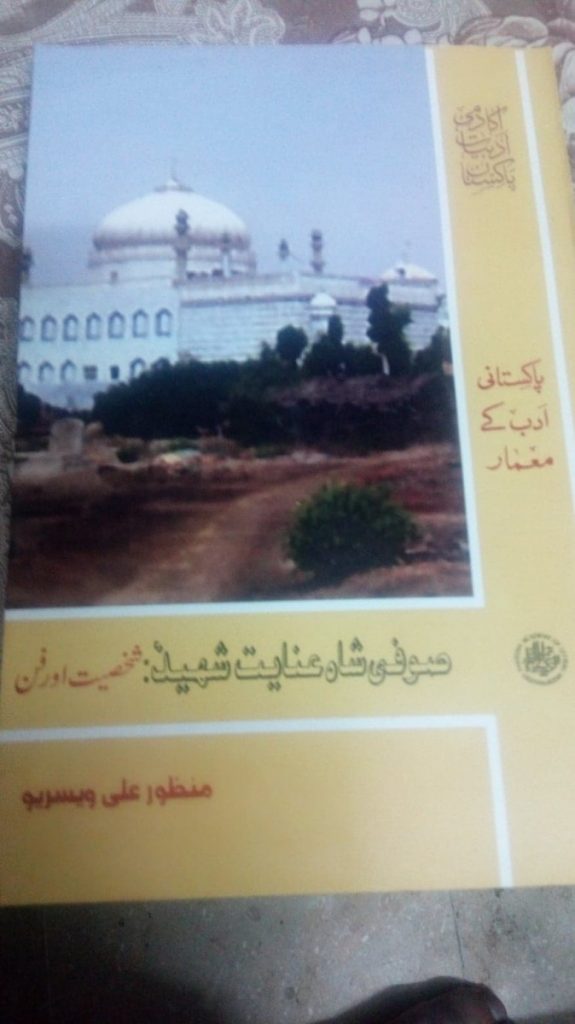
Manzoor Ali Veesrio
Sufi Shah Inayat Shaheed: Personality and Art
Sufi Shah Inayat had tried to bring collective farming – meaning a socialist mode of production and distribution – in the era of feudalism. However much worthy of admiration and praise this step of his may be – and worthy of respect the sacrifices of his comrades – nobody has an authority over the law of social evolution. However great a revolutionary any person is and how much he is intoxicated with the passion for social service, he cannot take precedence over this law.
The desire of Sufi Shah Inayat was noble, but destinies do not change by mere wishes. His dream was fortunate but he was dreaming about it at least two centuries in advance when to make this dream a reality neither material conditions were present nor the objective conditions were suitable. Neither the productive forces had progressed so much that the end of feudalism became inevitable and nor a consciousness of their historic character was created among the workers whose task it is to bring the socialist revolution (even now this consciousness is not there).
The working class of the 18th century in Sindh could not even think that political power should be seized from the nawabs and landlords to achieve power for themselves (the people of Jhok did not even reflect on capturing Thatta, what to talk of Sindh). In this situation, the experiment of Sufi Shah Inayat necessarily had to fail, so it did, albeit due to the deceptions of external powers rather than internal weaknesses.
Sufi Shah Inayat had no perception of the historic significance of his experiment and neither could he guess how deadly the movement for collective farming could prove for the landlords. Seemingly, this movement was no more than the waves of a pebble in the closed water of some small pond, but the Sufi was unaware of the reality that the energy of stormy surges is hidden in these waves which have the ability to emerge and wash away the whole feudal system like sticks and sprigs.
Why Sindh' peasants could not own the selfless struggle of fakirs as their struggle
He also did not have the ability to lead an armed struggle of the people. For example, when the fakirs advised that the army of the nawab should be attacked on its way by going forward so that the enemy would not get an opportunity to line up and surround Jhok, Sufi Shah Inayat refused to forestall and made do with just defensive contest. That is how the fighting was decided even before fighting broke out because defensive war is generally the preamble of defeat (The same mistake was also committed by the besieged army in Delhi in 1857 which provided the English with the opportunity to take armies and supplies from Punjab and other areas to attack Delhi).
Also read:The Martyrdom of Sufi Shah Inayat
By besieging themselves they gave a free hand to the enemy and broke their connection with the people of Sindh. This is the reason that the peasants of Sindh could not own the selfless struggle of the fakirs as their struggle. The result was that the fakirs of Jhok had to fight this war alone. No supporter or helper of theirs was created in Sindh, and this war of the fakirs could not assume greater importance than a momentary and local accident.
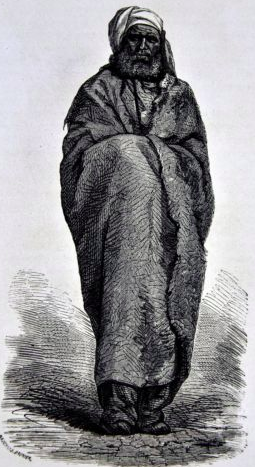
A Sindh peasant
Despite its failure, Shah Inayat's was a historic experiment
Whatever this trial, but is it any less of a historic feat that by undertaking the first successful experiment of collective farming he proved that if landowners and landlords do not intervene, farming can be done with better style and feelings of affinity and mutual assistance rather than rivalry and enmity. It is also clear that the oppressive power of the state until now has always supported the interest of the upper classes against the people. Alas that the mention of the invasions of Muhammad ibn Qasim, Mahmud Ghaznavi and Ahmad Shah Abdali is made with great emphasis in history textbooks, but our new generation in both Pakistan and India is not even aware of the name of Sufi Shah Inayat Shaheed.
This tradition of the sacrifice of the fakirs was further illuminated by Shahal Khan Kalhora, Naseer Muhammad Khan and Din Muhammad Khan, but woe to the expediencies of our historians who avoid the movement of the fakirs as if it is some ugly stain on the pages of history (These people would plough and sow land collectively and utilise the produce according to their need). It is true that it was impossible for this socialist movement to succeed within the confines of feudalism, but who can deny the sincerity and good intentions of the Kalhora fakirs?
Also, is it any less of a historic achievement that because of their sacrifices, an independent state emerged in Sindh after centuries; but alas that this independence was short-lived. First Nadir Shah came to loot, then Ahmad Shah Abdali subordinated northern Sindh, and when deliverance from Kabul was achieved, the East India Company came knocking.
And as Sajid Sarshaari says in his poetic tribute to Shah Inayat titled Jhok Men (At Jhok):
'The fragrance which has perfumed the whole of Sindh, "Sajid"
That fresh flower of the bouquet is to found at Jhok'
Note: Most of the quotations in this essay are from Maqalaat-us-Shuura (1760) and Tuhfat-ul-Kiram(1766), two books greatly detailing the conditions of Shah Inayat. These books are authored by Mir Ali Sher Qaane, who is an eminent historian, poet and biographical memoirist of Sindh, who wrote 42 books. Although he was a news-writer of the court of the Kalhoras, who were sworn enemies of Shah Inayat, he always mentions Shah Inayat with great respect and deference and narrates his conditions with great impartiality. The most superlative account in Urdu is to be found in Sufi Shah Inayat Shaheed: Personality and Art (2012) by Dr Manzoor Ali Veesrio, published by the Pakistan Academy of Letters in its "Architects of Pakistani Literature" series.
Raza Naeem is a Pakistani social scientist, book critic, and an award-winning translator and dramatic reader currently teaching in Lahore. He is also the president of the Progressive Writers Association in Lahore. His most recent work is an introduction to the reissued edition (HarperCollins India, 2016) of Abdullah Hussein's classic novel The Weary Generations . He can be reached at:razanaeem@hotmail.com .
Sufi Shah Inayat Shaheed Poetry
Source: https://thewire.in/history/sufi-shah-inayat-feudalism-collective-farming
0 Response to "Sufi Shah Inayat Shaheed Poetry"
Post a Comment