Toyota Continuous Improvement and Respect for People Scholarly Article
Toyota, Respect for People (or "Humanity") and Lean

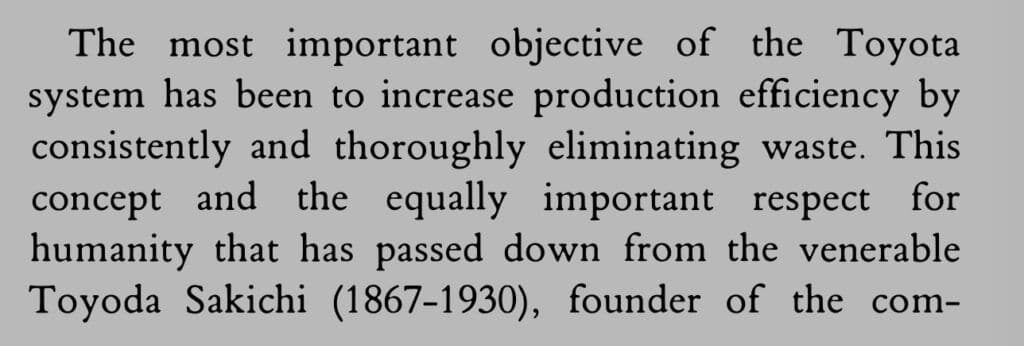
A principle that has been often discussed (and hopefully practiced) in the Lean community over the past few years is usually described as "respect for people."
A certain British
Let me explain why he's wrong — "respect for people" is not
When I was first taught about Lean and the Toyota Production System in the mid 90s, the focus was on tools (heijunka boards, kanban cards, 5S) and a few cultural elements (engage people in improvement, be in the "gemba") – but the phrase "respect for people" was not explicitly taught.
That phrase has only become widely discussed in the past five years or so, but it's not a recent invention – nor is it just a Western interpretation of Toyota's approach.
When I visited a Toyota plant in Japan last November, the term "respect for people" was highlighted for visitors. At the museum, you saw this display (large and prominent):
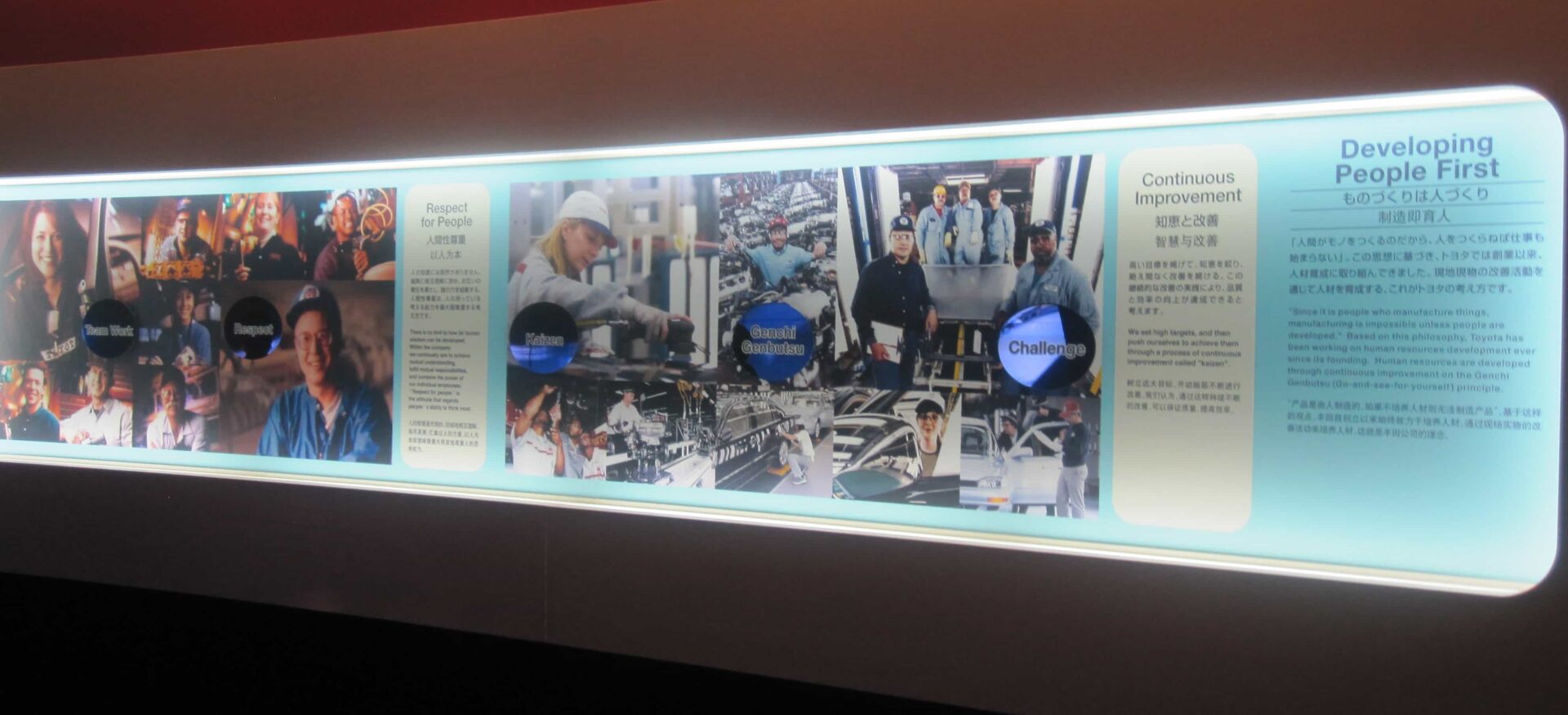
The two parts of "Developing People First" are "Respect for People" and "Continuous Improvement." These are often referred to as the two pillars of The Toyota Way management system (and I've seen them referred to as the "equally important pillars" by Toyota's legendary Taiichi Ohno – see page xiii of the book).
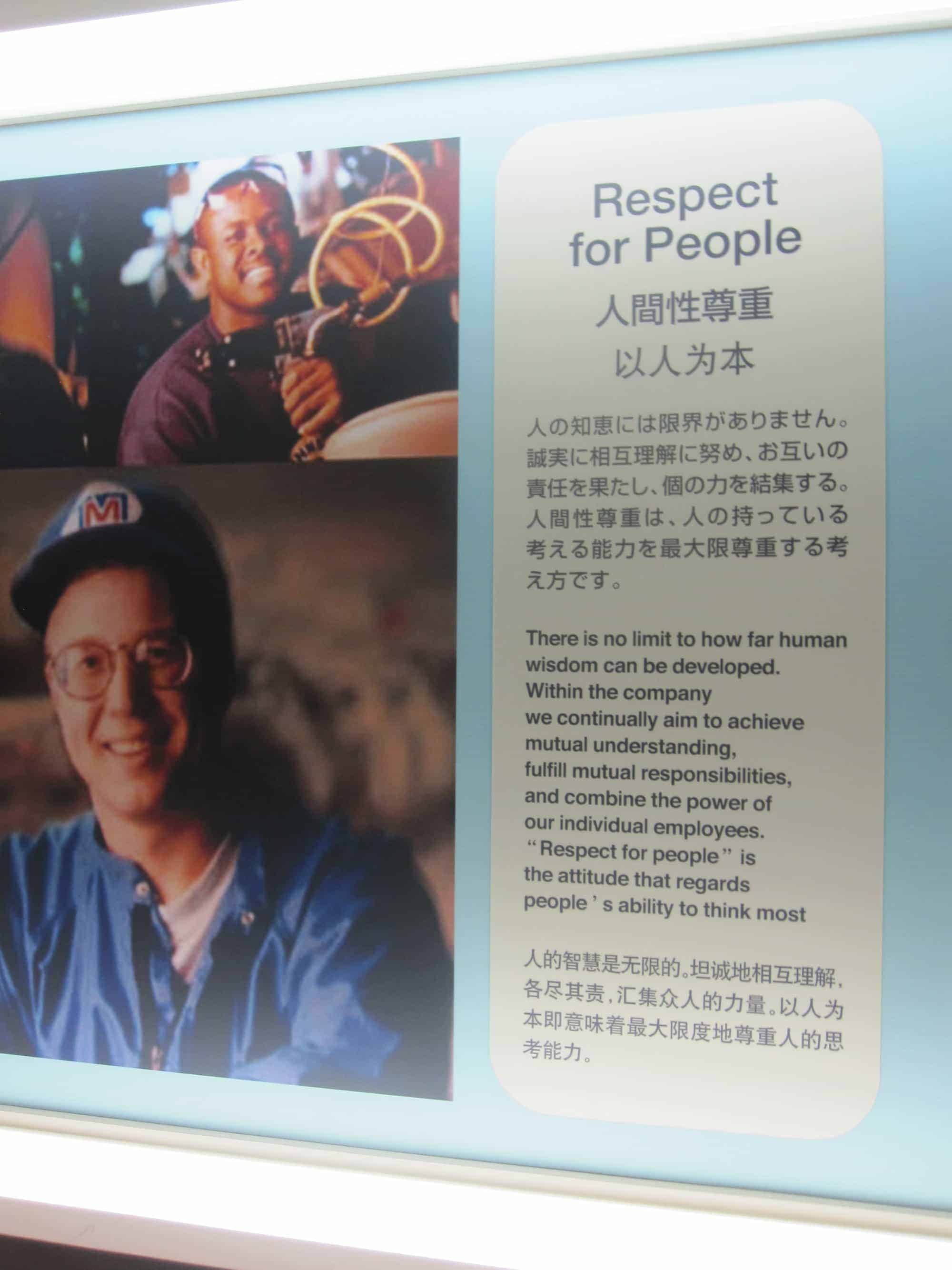
Here's a closer look at "respect for people" in the Toyota display:
The saucy Brit said that "respect for people" was a "consequence" of doing excellent work and that it, basically, isn't something you could focus on in and of itself.
The Toyota sign above says:
"respect for people is the attitude that regards people's ability to think most."
Does that sound like horse sh*t or a Western interpretation? It certainly appears that Toyota focuses on the attitude and behaviors as a fairly prominent goal of TPS.
Respect is not about being nice, nor is it about having great "people skills." It's about challenging people to perform to their peak ability, not being superficially nice.
Some perspectives and other reading on "respect for people":
A great post by Kaizen Institute's Jon Miller: "Exploring the "Respect for People" Principle of the Toyota Way."
Jon also goes back to some source Toyota documents to explore this idea and the difference in wording between "valuing" and "respecting" people, as well as the difference between saying "people" and "humanity" or "humanness."
Jim Womack of the Lean Enterprise Institute wrote an e-Letter about five years ago that does a great job of comparing how Western companies normally view "respect" versus the Lean view.
Mike Rother explores this idea, including being "challenging" as a way of showing respect in his post:
In studying Toyota I often got the impression that respect for people means that it's disrespectful of people to not utilize their human capability to learn and to grow.
Of course, author and professorBob Emiliani deserves a lot of credit for highlighting "respect for people" consistently in his writing:
Toyota does not use one simple, discrete definition to express the "Respect for People" principle, whose context is better represented by the phrase "Respect for Stakeholders". Rather, it is a more elaborate multi-layered description that includes historical words from former Toyota executives to better comprehend its meaning. Toyota's top-level representation of the "Respect for People" principle consists of two parts: "Respect" and "Teamwork," and is as follows:
"RESPECT: We respect others, make every effort to understand each other, take responsibility and do our best to build mutual trust.
TEAMWORK: We stimulate personal and professional growth, share the opportunities of development and maximize individual and team performance."
Author Natalie Sayer (Lean for Dummies) had an excellent guest post here on my site,Respect for People Goes in All Directions.
"We as individuals will contribute to a culture of 'Respect for People' just by how we show up in each moment. It starts with self-awareness and personal accountability for our own leadership. Ask yourself, 'Am I:
* continuing to grow, learn, and develop?
Natalie Sayer
* building capability with those around me?
* coaching and acknowledging others?
* using language constructively, listening and communicating effectively?
* contributing to the development of a Lean culture?
* actively improving processes and solving problems?
* being accountable to the results, as well as, the process to achieve them?…"
And Art Smalley does a nice job of explaining the history that shows "respect for people" is not a recent invention and some of the first and foremost ways of showing respect including having a safe work environment.
"About a decade ago Toyota simplified its philosophy down to the two pillars mentioned – continuous improvement and respect for people. It is true that you won't find much written about "respect for people" but that is not to say that Toyota does not emphasize the concept in some obvious ways. The roots for the concept inside Toyota at least date back to Sakichi Toyoda's founding precepts in the 1930s or earlier depending upon the version."
You can read Jeff Liker's books on Toyota, where respect for people is a core theme and he also had this blog post:
"In fact, within Toyota they say respect for people is the foundation for continuous improvement. And a key component of respect for people is investing in them, in training, job security, and their morale. It is very important to understand that the concept of making investments does not disappear with lean."
@SeanStickle writes this on his blog, referencing the philosopher Kant:
"Respect for people does not mean that we must like the people we work with, or get along with them, or even think they are good people. It means that we understand that they are moral peers, not merely instruments suited for some business purpose."
I've really come to appreciate how "respect for people" and "continuous improvement" (or Kaizen) are intertwined. We practice CI because we have RFP… we practice RFP by engaging people in CI and by challenging them to perform better… for the sake of our customers and our patients (for whom we also have respect).
What do you think? Scroll down to comment or share your thoughts and the post on social media. Don't want to miss a post or podcast? Subscribe to get notified about posts via email daily or weekly.

- About
- Latest Posts

Source: https://www.leanblog.org/2013/02/toyota-respect-for-people-or-humanity-and-lean/