Floaters That Are Black in Reading Eye Go Away
What causes eye floaters and how to treat them
- What are eye floaters?
- What causes center floaters?
- When are eye floaters near visible?
- When are eye floaters a medical emergency?
- What causes vitreous detachment?
- What causes eye flashes?
- Other conditions associated with eye floaters and flashes
- How to get rid of eye floaters
- Laser treatment for center floaters
- What happens during light amplification by stimulated emission of radiation treatment?
What are eye floaters?
Heart floaters are tiny black spots in your vision. They are those spots, dots, specks, rings or "cobwebs" that drift frantically effectually in your field of vision. While annoying, eye floaters, also simply called floaters , are very common and usually aren't cause for alarm.
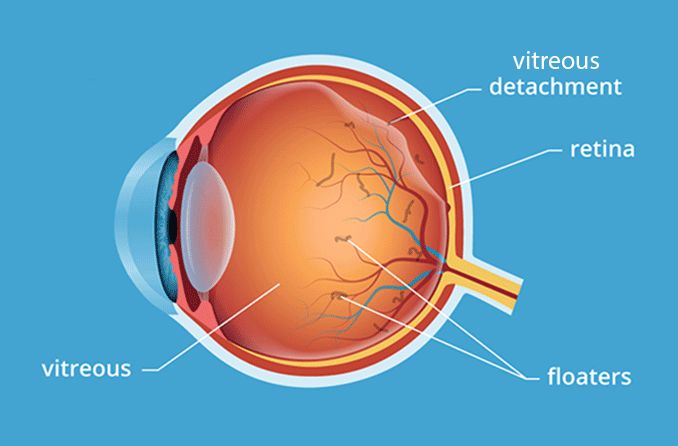
Floaters develop in the clear, gel-like vitreous that fills the dorsum chamber of the eye and which is responsible for giving the center its globe-like shape. For this reason, centre floaters also are called vitreous floaters.
What causes eye floaters?
Eye floaters are caused past irregularly shaped clumps of collagen that bladder effectually in the liquefied vitreous torso, and can bear upon light passing through the heart. When they float close to the light-sensitive retina in the back of the eye, they cast shadows on the retina, and these shadows are what we perceive as middle floaters.
The vitreous trunk is mostly h2o, only information technology too contains a poly peptide chosen collagen. As we age, the vitreous office becomes less like a gel and more watery. When this occurs, $.25 of collagen in the vitreous tin can dodder together and class lint-like structures. These are what cause those squiggly lines in your vision.
When are centre floaters about visible?
You're nigh likely to notice vitreous floaters when y'all gaze at a clear or clouded sky. They often announced in your peripheral vision, which makes information technology easy to mistake a floater for an insect flying in front of your face.
Another time people detect floaters is when they're staring at a computer screen that has a white or low-cal-colored groundwork.
One time you start seeing floaters, it can be hard to ignore them, especially if you lot are stressed or drawn.
Because the clumps of collagen that crusade floaters are often suspended in the periphery of the vitreous, it can be impossible to look directly at them. When you lot move your center to try and see meliorate, the floater moves in the same management and floats dorsum into your peripheral vision and out of view.
When are heart floaters a medical emergency?
Noticing a few floaters from time to time is not a cause for business concern. However, if yous see a shower of floaters and spots, especially if they are accompanied past flashes of calorie-free, yous should seek medical attending immediately from an centre intendance professional.
The sudden appearance of these symptoms tin can mean that the vitreous is pulling away from your retina, a status called posterior vitreous detachment (PVD), or information technology could mean that the retina itself is becoming dislodged from the back of the heart's inner lining, which contains blood, nutrients and oxygen vital to healthy part.
As the vitreous gel tugs on the delicate retina, information technology might cause a small tear or hole in it. When the retina is torn, vitreous can enter the opening and button the retina farther abroad from the inner lining of the back of the eye, and a retinal detachment can result.
In cases of retinal tear or detachment, handling must occur as soon equally possible and then that an eye surgeon can reattach the retina and restore visual function before sight is lost permanently.
A report of 350 patients with PVD published in the journal Ophthalmology found that, of 163 patients who came to the dispensary because of symptoms of but ane or two floaters (with or without lite flashes), a retinal tear developed in 12 of them (seven.3%).
Based on this finding, if you suddenly develop large floaters, even if you don't feel flashes of calorie-free, information technology'southward a good idea to see your eye medico immediately to brand sure the floaters are no cause for concern.
What causes vitreous detachment?
As mentioned in a higher place, posterior vitreous detachments (PVDs) are mutual causes of vitreous floaters. Far less normally, these symptoms can be associated with retinal tears or detachments that may be linked to PVDs.
Every bit the eye develops early in life, the vitreous gel fills the inside of the back of the middle and presses against the retina and attaches to the surface of the retina. Over time, the vitreous becomes more liquefied in the center. This sometimes means that the central, more watery vitreous cannot support the weight of the heavier, more peripheral vitreous gel. The peripheral vitreous gel then collapses into the key, liquefied vitreous, detaching from the retina (similar Clot-O separating from the inside of a gelatin mold or bowl).
Heart floaters resulting from a posterior vitreous detachment are then concentrated in the more liquid vitreous found in the interior center of the center.
It'due south estimated that more one-half of all people will take a posterior vitreous detachment by age eighty. Thankfully, most of these PVDs do not lead to a torn or detached retina.
Light flashes during this process mean that traction is being practical to your retina while the PVD takes place. Once the vitreous finally detaches and pressure on the retina is eased, the light flashes should gradually subside.
What causes middle flashes?
Normally, light entering your heart stimulates the retina. This produces an electric impulse, which the optic nervus transmits to the brain. The brain then interprets this impulse as low-cal or some type of image.
If the retina is mechanically stimulated (physically touched or tugged), a similar electric impulse is sent to the brain. This impulse is so interpreted as a "flicker" of light.
When the retina is tugged, torn or discrete from the dorsum of the eye, a flash or flicker of light commonly is noticed. Depending on the extent of the traction, tear or disengagement, these flashes of calorie-free might be short-lived or continue indefinitely until the retina is repaired.
Flashes of light (photopsias) also may occur after a accident to the head that is capable of shaking the vitreous gel within the eye. When this occurs, the phenomenon sometimes is called "seeing stars."
Some people experience flashes of lite that announced equally jagged lines or "heat waves" in both eyes, oft lasting 10 to twenty minutes. These types of flashes are usually caused past a spasm of claret vessels in the brain.
If a headache follows the visual disturbances (including flashes of light), it is called a migraine with aura. But if the flashes occur without a subsequent headache, this is called an ocular migraine.
Photopsia also can be a symptom of digitalis toxicity, which tin occur particularly in older people who have digitalis or related drugs for center problems.
Other conditions associated with heart floaters and flashes
When a PVD is accompanied by bleeding inside the heart (vitreous hemorrhage), it means the traction that occurred may have torn a small claret vessel in the retina. A vitreous hemorrhage increases the possibility of a retinal tear or detachment.
Traction exerted on the retina during a PVD too can pb to development of conditions such equally macular holes or puckers.
Vitreous detachments with accompanying eye floaters too may occur in circumstances such equally:
-
Inflammation in the eye's interior
-
Nearsightedness
-
Cataract surgery
-
YAG laser eye surgery
-
Diabetes (diabetic vitreopathy)
-
CMV retinitis
Inflammation associated with many weather such as eye infections tin can cause the vitreous to liquefy, leading to a PVD.
When you are nearsighted, your eye's elongated shape too can increase the likelihood of a PVD and accompanying traction on the retina. In fact, nearsighted people are more likely to have PVDs at a younger age.
PVDs are very common post-obit cataract surgery and a follow-up process chosen a YAG laser capsulotomy. Months or fifty-fifty years after cataract surgery, it's not unusual for the thin membrane (or "sheathing") that's left intact behind the intraocular lens (IOL) to become cloudy, affecting vision. This delayed cataract surgery complication is called posterior capsular opacification (PCO).
In the capsulotomy procedure used to treat PCO, a special type of laser focuses energy onto the cloudy capsule, vaporizing the central portion of it to create a articulate path for lite to reach the retina, which restores clear vision.
Manipulations of the eye during cataract surgery and YAG laser capsulotomy procedures cause traction that can pb to posterior vitreous detachments.
How to get rid of eye floaters
Most middle floaters and spots are harmless and but annoying. Many floaters will fade over fourth dimension and become less bothersome. In most cases, no eye floater handling is required.
However, big persistent floaters tin can be very troubling to some people, causing them to seek a way to get rid of centre floaters and spots globe-trotting in their field of view.
In the past, the only handling for eye floaters was an invasive surgical process called a vitrectomy. In this procedure, some or all of the vitreous is removed from the eye (forth with the eye floaters inside it) and is replaced with a sterile clear fluid.
But the risks of a vitrectomy can outweigh the benefits for eye floater treatment. These risks include surgically induced retinal detachment and serious eye infections. On rare occasions, vitrectomy surgery can cause new or fifty-fifty more floaters. For these reasons, near center surgeons do not recommend vitrectomy to treat heart floaters and spots.
Light amplification by stimulated emission of radiation treatment for eye floaters
A less invasive light amplification by stimulated emission of radiation procedure chosen light amplification by stimulated emission of radiation vitreolysis is commonly a much safer alternative to vitrectomy for center floater treatment. In this in-role procedure, a laser beam is projected into the center through the student and is focused on large floaters, which breaks them apart and/or frequently vaporizes them then they disappear or become much less bothersome.
To determine if you may benefit from laser vitreolysis to get rid of eye floaters, your eye medico will consider several factors, including:
-
Your age
-
How quickly your symptoms started
-
What your floaters expect similar
-
Where the floaters are located
The floaters in patients younger than age 45 tend to be located too close to the retina and can't be safely treated with light amplification by stimulated emission of radiation vitreolysis. Patients with sizable eye floaters located farther away from the retina are amend suited to the procedure.
The ophthalmologist who performs light amplification by stimulated emission of radiation vitreolysis also will evaluate the shape and borders of your eye floaters. Those with "soft" borders often can be treated successfully. Also, sizable floaters that appear suddenly as a result of a posterior vitreous disengagement ofttimes tin be successfully treated with the laser procedure.
What happens during laser treatment?
Laser vitreolysis usually is hurting-complimentary and can exist performed in your ophthalmologist's function. Just prior to the handling, anesthetic eye drops are applied and a special type of contact lens is placed on your center. Then, the physician will look through a biomicroscope (slit lamp) to precisely deliver the laser energy to the floaters being treated.
During the procedure, you might notice dark spots. These are pieces of broken upward floaters. The treatment can take up to a half hour, only it'due south usually significantly shorter.
At the cease of the procedure, the contact lens is removed, your eye is rinsed with saline and the doctor volition apply an anti-inflammatory heart driblet. Additional centre drops may be prescribed for you to use at abode.
Sometimes, you may run across small night spots shortly after treatment. These are pocket-sized gas bubbling that tend to resolve chop-chop. There also is a chance that you lot'll accept some balmy discomfort, redness or blurry vision immediately after the procedure. These effects are common and typically won't preclude y'all from returning to your normal activities immediately following laser vitreolysis.
Your md will usually schedule follow-up for the following solar day. At that time, you may demand a second treatment.
If you are bothered by large, persistent centre floaters, ask your eye medico if laser vitreolysis might be a expert handling pick for your state of affairs.
Recall, a sudden appearance of a significant number of eye floaters, especially if they are accompanied by flashes of low-cal or other visual disturbances, could signal a detached retina or other serious problem in the eye. If you lot suddenly run across new floaters, visit your centre doctor without filibuster.
READ NEXT: Asteroid hyalosis: causes, symptoms and treatments
Folio published in March 2019
Page updated in January 2022
Source: https://www.allaboutvision.com/conditions/spotsfloats.htm
0 Response to "Floaters That Are Black in Reading Eye Go Away"
Post a Comment