Which of the Following Is Not One of the Ways Photography Influenced Art?
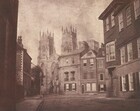
The 19th Century: The Invention of Photography William Henry Fox Talbot, British, 1800–1877, A Scene in York: York Minster from Lop Lane, 1845, salted paper print, Edward J. Lenkin Fund, Melvin and Thelma Lenkin Fund, and Stephen G. Stein Fund, 2011.57.1 A British polymath equally skillful in astronomy, chemistry, Egyptology, physics, and philosophy, Talbot spent years inventing a photographic procedure that created paper negatives, which were then used to make positive prints—the conceptual basis of nearly all photography until the digital historic period. Calotypes, as he came to call them, are softer in result than daguerreotypes, the other process announced in 1839. Though steeped in the sciences, Talbot understood the ability of his invention to make striking works of art. Here the partially obstructed view of the cathedral rising from the confines of the city gives a sense of discovery, of having just turned the corner and encountered this scene.
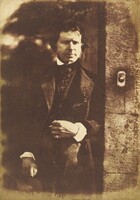
The 19th Century: The Invention of Photography David Octavius Hill and Robert Adamson, Scottish, 1802–1870, and Scottish, 1821–1848, David Octavius Loma at the Gate of Rock Business firm, Edinburgh, 1843–1847, salted newspaper impress, Paul Mellon Fund, 2007.29.27 In the mid-1840s, the Scottish squad of Colina, a painter, and Adamson, a photographer who had opened the start photography studio in Edinburgh, produced some of the finest pictures made with the newly invented medium. Theirs was a true partnership of technical skills and inventiveness. In the four brief years of their alliance before Adamson'south untimely death, they created some three thou portraits and pictures of local life. This picture of Hill, made at the entrance to his studio, is characteristic of the partners' deft harnessing of light and shadow to model the subject's face, suggesting a psychological intensity.
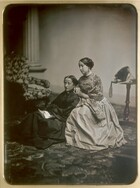
The 19th Century: The Invention of Photography Albert Sands Southworth and Josiah Johnson Hawes, American, 1811–1894, and American, 1808–1901, The Letter, c. 1850, daguerreotype, Patrons' Permanent Fund, 1999.94.1 Working together in Boston, the portrait photographers Southworth and Hawes aimed to capture the graphic symbol of their subjects using the daguerreotype procedure. Invented in France and 1 of the 2 photographic processes introduced to the public in early on 1839, the daguerreotype is made by exposing a silver-coated copper plate to light and then treating it with chemicals to bring out the image. The heyday of the technique was the 1840s and 1850s, when information technology was used primarily for making portraits. The daguerreotype's long exposure time normally resulted in frontal, frozen postures and stern facial expressions; this picture's pyramidal composition and strong sentiments of friendship and companionship are characteristic of Southworth and Hawes'due south innovative approach.
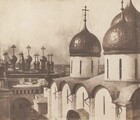
The 19th Century: The Invention of Photography Roger Fenton, British, 1819–1869, Moscow, Domes of Churches in the Kremlin, 1852, salted paper impress, Paul Mellon Fund, 2005.52.1 Trained as a lawyer and painter, Fenton photographed for only xi years, all the same he was one of United kingdom of great britain and northern ireland's most influential and skilled practitioners. The starting time official lensman to the British Museum, he was besides one of the founders of the Photographic Lodge, an organization he hoped would establish photography's importance in modern life. He constantly tested the limits of his practice, fifty-fifty hauling his cumbersome equipment abroad to places such as Russia, where he made this photograph as part of a remarkable serial of architectural views of the Kremlin.

The 19th Century: The Invention of Photography Roger Fenton, British, 1819–1869, Fruit and Flowers, 1860, albumen print, Paul Mellon Fund, 2005.52.4
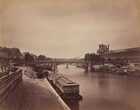
The 19th Century: The Invention of Photography Gustave Le Gray, French, 1820–1884, The Pont du Carrousel, Paris: View to the West from the Pont des Arts, 1856–1858, albumen print, Patrons' Permanent Fund, 1995.36.94 Early Decades of Photography in France (Slides 6–9) In the second one-half of the nineteenth century, some photographers in France, hired past governmental agencies to make photographic inventories or just catering to the growing demand for pictures of Paris, drew on the medium's documentary abilities to record the nation'southward architectural patrimony and the modernization of Paris. Others explored the camera's artistic potential by capturing the ephemeral moods of nature in the French countryside. Though photographers faced difficulties in carting around heavy equipment and operating in the field, they learned how to master the elements that direct affected their pictures, from securing the right vantage bespeak to dealing with movement, light, and irresolute atmospheric conditions during long exposure times.
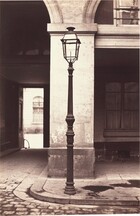
The 19th Century: The Invention of Photography Charles Marville, French, 1813–1879, Hôtel de la Marine, 1864–1870, albumen impress, Diana and Mallory Walker Fund, 2006.23.i
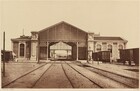
The 19th Century: The Invention of Photography Édouard-Denis Baldus, French, 1813–1889, Toulon, Train Station, c. 1861, albumen impress, Patrons' Permanent Fund, 1995.36.10
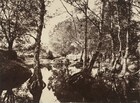
The 19th Century: The Invention of Photography Eugène Cuvelier, French, 1837–1900, Belle-Croix, 1860s, albumen print, Gail and Benjamin Jacobs for the Millennium Fund, 2007.115.one
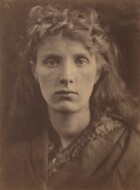
The 19th Century: The Invention of Photography Julia Margaret Cameron, British, 1815–1879, The Mount Nymph, Sweet Liberty, June 1866, albumen impress, New Century Fund, 1997.97.ane Ensconced in the intellectual and artistic circles of midcentury England, Cameron manipulated focus and light to create poetic pictures rich in references to literature, mythology, and history. Her monumental views of life-sized heads were unprecedented, and with them she hoped to define a new style of photography that would rival the expressive ability of painting and sculpture. The title of this work alludes to John Milton'due south mid-seventeenth-century poem "Fifty'Allegro." Describing the happy life of one who finds pleasure and dazzler in the countryside, the verse form includes the lines: Come, and trip information technology as ye get
On the calorie-free fantastic toe;
And in thy right hand pb with thee,
The mountain nymph, sugariness Liberty.

The 19th Century: The Invention of Photography Maria Harriet Elizabeth Cator, British, 1831–1881, Cator Family unit Anthology (detail), 1866–1877, collage of watercolor and albumen prints in bound volume, Pepita Milmore Memorial Fund, 2014.174.1 In mid-nineteenth-century Britain, upper-class women frequently created collages out of small, commercial portrait photographs of family and friends, cutting out heads and figures and pasting them onto paper that they then embellished with drawings and watercolor. Made decades earlier the twentieth-century advanced discovered the provocative allure of photocollage, these inventive, witty, and whimsical pictures undermined the standards of respectability seen in much studio portrait photography of the fourth dimension.
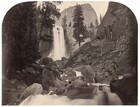
The 19th Century: The Invention of Photography Carleton Due east. Watkins, American, 1829–1916, Piwac, Vernal Falls, 300 anxiety, Yosemite, 1861, albumen print, Souvenir of Mary and David Robinson, 1995.35.23 The w expansion of America opened upward new opportunities for photographers such as Watkins and William Bell (encounter the following slide). Joining authorities survey expeditions, hired by railroad companies, or catering to tourists and the growing need for g views of nature, they created photographic landscapes that reached a broad audience of scientists, businessmen, and engineers, as well as curious members of the middle class. Watkins's photographs of the sublime Yosemite Valley, which often think landscape paintings of like majestic subjects, helped convince Congress to laissez passer a nib in 1864 protecting the area from development and commercial exploitation.

The 19th Century: The Invention of Photography William H. Bell, American, built-in England, 1830–1910, One thousand Cañon, Colorado River, Most Paria Creek, Looking West, 1872, in Geographical and Geological Explorations and Surveys West of the 100th Meridian, Seasons of 1871, 1872, and 1873 (1873), albumen impress in bound volume, Corcoran Collection (Gift of William Wilson Corcoran, 1886)

The 19th Century: The Invention of Photography Guillaume-Benjamin-Amant Duchenne (de Boulogne), French, 1806–1875, Plate 63, Fright, from Mécanisme de la physionomie humaine (The Machinery of Human Facial Expression) (1862), 1854–1855, albumen print, Pepita Milmore Memorial Fund A neurologist, physiologist, and photographer, Duchenne de Boulogne conducted a series of experiments in the mid-1850s in which he applied electrical currents to diverse facial muscles to written report how they produce expressions of emotion. Convinced that these electrically-induced expressions accurately rendered internal feelings, he then photographed his subjects to found a precise visual lexicon of homo emotions, such as pain, surprise, fearfulness, and sadness. In 1862 he included this photo representing fright in a treatise on physiognomy (a pseudoscience that assumes a relationship betwixt external appearance and internal character), which enjoyed broad popularity amongst artists and scientists.

The 19th Century: The Invention of Photography Eadweard Muybridge, American, born England, 1830–1904, Plate 365, Head-leap, a flying pigeon interfering, from Creature Locomotion, 1887, collotype, Corcoran Collection (Museum purchase, 1887) Muybridge'due south experiments in the 1880s revolutionized the agreement of motility and inspired scientists and artists alike. Using banks of cameras equipped with precisely triggered shutters, he captured sequences of pictures of people and animals moving and performing simple actions, such as climbing stairs or, as hither, performing a head-spring. Showing pocket-size increments of movements, his work made visible what one time was imperceptible to the human being eye and laid the foundation for motion pictures.
Source: https://www.nga.gov/features/in-light-of-the-past/the-19th-century-the-invention-of-photography.html
0 Response to "Which of the Following Is Not One of the Ways Photography Influenced Art?"
Post a Comment